Artificial intelligence is no longer just a topic for developers, data scientists, or tech companies. From sales to marketing, human resources to finance operations, education to customer experience, almost every business field is being reshaped by AI.
For anyone who wants to be a part of this transformation, one of the most important questions is this:
"How can I prove myself in the field of AI?"
One of the most practical answers to this question is to get the right AI certifications and back them up with real-world projects.
What is an AI Certification?
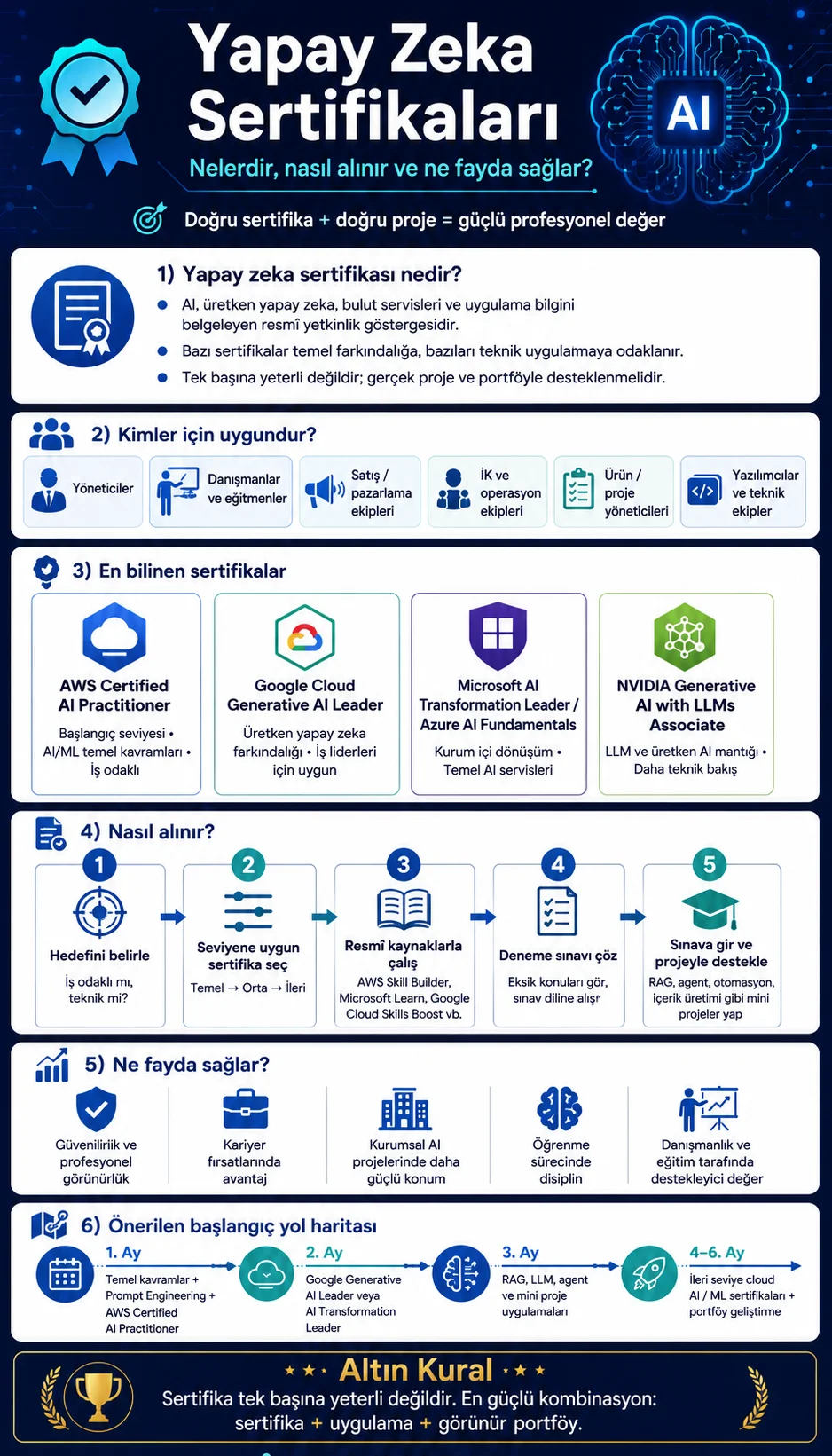
An AI certification is a document proving that an individual has a certain level of knowledge in topics such as artificial intelligence, machine learning, generative AI, cloud-based AI services, data analysis, or AI project management.
Some certifications focus on awareness and foundational concepts. Others cover more advanced topics like technical implementation, model development, cloud AI services, RAG, agents, MLOps, or generative AI solutions.
The key point here is this: a certification alone does not mean expertise. But when the right certification is combined with the right learning process and real-world application examples, it creates a strong professional signal.
Who Are AI Certifications For?
AI certifications are not just for developers. Today, many AI certifications are also designed for non-technical professionals.
These certifications are particularly beneficial for the following groups:
Managers who want to leverage AI in their business processes
Consultants and trainers
Sales, marketing, and customer experience teams
Human resources and operations teams
Product managers and project managers
Developers and technical teams
Professionals looking to transition into data analytics and automation
Leaders looking to manage AI transformation within their organization
So, the goal isn't just to "learn how to build models." The goal is to properly understand AI, use it in the right place, know its risks, and turn it into business value.
The Most Popular AI Certifications
There are many different certifications in the field of AI. We can divide them into three groups based on their level.
1. Beginner and AI Literacy Certifications
These certifications are suitable for beginners in AI. Without diving too deep into technical details, they teach foundational concepts, use cases, and their business impact.
AWS Certified AI Practitioner
AWS Certified AI Practitioner is a great entry-level certification for those who want to understand AI and machine learning concepts through the AWS ecosystem.
This certification is particularly suitable for professionals who do not have to develop AI solutions but want to get familiar with AI/ML technologies.
Who is it for?
Consultants
Instructors
Business analysts
Product managers
Sales and marketing teams
Anyone looking to earn their first official certification in the field of AI
Google Cloud Generative AI Leader
Google Cloud Generative AI Leader is suitable for those who want to understand generative AI concepts and the generative AI approach within the Google Cloud ecosystem.
It is particularly beneficial for individuals who want to build AI awareness within organizations, evaluate AI use cases, and more accurately interpret generative AI projects.
Microsoft AI Transformation Leader
Microsoft AI Transformation Leader focuses on business transformation, AI adoption strategy, and scaling AI usage within the organization, rather than technical development.
This certification is especially valuable for managers, business leaders, consultants, and internal transformation leads.
Microsoft Azure AI Fundamentals
Azure AI Fundamentals is designed for those who want to learn AI concepts and core AI services on Microsoft Azure.
This certification can be helpful for those looking to kickstart a technical career. However, since Microsoft exam codes and certification structures can change periodically, it is best to check the current exam code before applying.
2. Generative AI and LLM-Focused Certifications
These certifications are more suitable for those interested in large language models like ChatGPT, Claude, Gemini, Llama, Mistral, and generative AI solutions.
NVIDIA Generative AI with LLMs Associate
This certification is suitable for people who want to gain a more technical perspective on generative AI and large language models.
It can be a strong option for anyone looking to understand LLM logic, model behaviors, core generative AI concepts, and their application areas.
Databricks Generative AI Engineer Associate
Generative AI certifications on the Databricks side lean more toward data, RAG, vector search, MLflow, and developing AI applications with enterprise data.
These certifications make more sense for technical teams who want to build real enterprise applications, rather than those who just want to learn AI concepts.
3. Technical and Advanced AI Certifications
These certifications require more technical depth. They cover machine learning, model development, data preparation, MLOps, cloud services, and production deployment.
AWS Machine Learning Engineer / Specialty Certifications
It is suitable for those looking to develop machine learning projects, train and deploy models, and work with AI services at a more technical level on AWS.
Before moving on to these types of certifications, you should already have a grasp of basic AI concepts and AWS services.
Google Professional Machine Learning Engineer
This is a more advanced certification for technical professionals who want to design, build, and manage machine learning solutions on Google Cloud.
This certification should generally be considered after the foundational level.
Microsoft Azure AI Engineer / AI Developer Certifications
It is suitable for those who want to develop AI applications, bots, agent architectures, Azure OpenAI, cognitive services, and AI-based solutions on Microsoft Azure.
It is more relevant for technical teams, developers, and cloud developer profiles.
Which Certification Makes the Most Sense to Start With?
When choosing an AI certification, you first need to answer this question:
"For what purpose do I want to learn AI?"
If your goal is to understand and use AI in your professional life, entry-level certifications are the better choice.
If your goal is to consult for organizations, design training programs, or manage AI transformation, business leadership and generative AI-focused certifications are more beneficial.
If your goal is to develop models, build RAG systems, develop agents, or create cloud AI solutions, you should focus on technical certifications.
The recommended roadmap could look like this:
How to Get an AI Certification
The general process for obtaining an AI certification is as follows:
1. Define Your Goal
First, clarify why you want to get the certification.
Is the goal to stand out in job interviews?
To deliver corporate training?
To develop AI projects?
Or to lead the AI transformation within the company?
Choosing a certification without a clear goal in mind can waste your time.
2. Choose the Right Certification for Your Level
If you're just starting out in AI, jumping straight into advanced machine learning certifications can hurt your motivation.
It's much better to start with AI literacy, generative AI, and foundational cloud AI certifications first.
3. Use Official Training Resources
The safest bet is to start with official resources like AWS Skill Builder for AWS, Google Cloud Skills Boost for Google, Microsoft Learn for Microsoft, and the NVIDIA Deep Learning Institute for NVIDIA.
You can use Udemy, Coursera, YouTube, or private training platforms as supplementary resources. However, you should always verify the exam scope against the official exam guide.
4. Take Notes While Studying
Simply memorizing definitions isn't enough for AI certification exams. You need to learn concepts along with their real-world use cases.
For example:
When should you use RAG?
What is the difference between fine-tuning and RAG?
Should personal data be fed into a model within an organization?
When should you use Amazon Bedrock versus SageMaker?
How do you validate generative AI outputs?
How to reduce model hallucination?
Being able to give logical answers to these questions is as important for real-world work as it is for exam success.
5. Take Practice Exams
You should definitely take practice exams before sitting for the certification exam.
Practice exams provide two main benefits:
First, you get used to the exam language.
Second, you see which areas you're lacking in.
Instead of just marking the questions you got wrong, try to understand why you got them wrong.
6. Schedule Your Exam
Many certification exams can be taken online proctored or at a testing center. Online exams may have rules regarding ID verification, camera, microphone, and desk setup.
Therefore, it is important to check the technical requirements before the exam.
What Are the Benefits of AI Certifications?
1. Builds Credibility
Talking about AI is easy, but documenting your knowledge sends a much stronger signal.
A certification sends the message: "this person has met a certain standard in AI."
2. Increases Career Opportunities
AI has now become an added skill for many roles. Having AI knowledge provides a significant advantage in fields like sales, marketing, operations, human resources, training, software development, and consulting.
3. It Positions You Better in Enterprise Projects
When discussing an AI project within an organization, just knowing how to use tools isn't enough. People who understand the concepts, risks, data security, and business impact become much more valuable.
This is where certifications build professional credibility.
4. It Disciplines the Learning Process
Targeting a certification makes the learning process much more structured.
Instead of watching random videos, studying according to the exam syllabus ensures you learn the topics systematically.
5. It Serves as Great Support When Providing Consulting and Training
For anyone providing AI training, consulting, or driving AI transformation in organizations, certifications serve as a strong validation.
Of course, a certification alone is not enough. But when combined with experience, hands-on projects, case studies, and training content, it provides a major professional advantage.
Is a Certification Enough on Its Own?
No.
Getting certified in AI is important, but it's not enough on its own. A certification shows your knowledge level, while a project proves you can actually apply that knowledge.
That's why it's crucial to build small projects alongside every certification journey.
For example:
Personal AI assistant prototype
PDF summarization tool
RAG-based document Q&A system
Customer email analysis tool
AI-powered educational content generation system
Simple no-code automation workflow
Sample portfolio of image, video, and music generation
These projects can be shared on LinkedIn, a personal website, or a portfolio page.
What to Consider When Choosing an AI Certification?
When choosing a certification, you should consider the following criteria:
Is the issuing institution reputable?
Does the certification cover current AI trends?
Is it technical or business-oriented?
Are the exam language and format right for you?
Are the preparation resources sufficient?
Does the certification align with your career goals?
Does it have a validity period?
Are the exam fee and retake cost reasonable?
Especially with tech certifications, exam content and codes can change over time. Therefore, you should always check the official certification page before applying.
Recommended Beginner Roadmap
For someone just starting out with AI certifications, a practical roadmap could look like this:
Month 1
Learn AI fundamentals.
Prepare for AWS Certified AI Practitioner or a similar beginner certification.
Study prompt engineering and generative AI use cases.
Month 2
Target a business-focused certification like Google Generative AI Leader or Microsoft AI Transformation Leader.
Develop a small AI use case during this process.
Month 3
Move on to more hands-on certifications like Azure AI Fundamentals, NVIDIA Generative AI with LLMs Associate, or similar.
Deepen your understanding of RAG, agent, LLM, and data security concepts.
Months 4–6
If you have a technical goal, prepare for cloud AI, machine learning engineer, or generative AI engineer certifications.
Develop 2–3 small projects for your portfolio.
Conclusion
AI certifications are a great starting point for professionals looking to improve themselves in this field. However, what really makes the difference is not just getting certified, but being able to apply that knowledge to real-world business problems.
In today's business world, AI literacy is no longer an extra skill—it's becoming a fundamental professional competency. You can validate this competency with the right certifications and bring it to the field with the right projects.
The best approach is this:
First learn the core concepts, then use generative AI tools, next apply them with small projects, and finally, make this capability visible with certifications.
Those who stand out in the AI era won't just be the tool users; they will be the ones who ask the right questions, identify the right risks, and translate technology into real business value.
| Level | Certification Type | Objective |
|---|---|---|
| Beginner | AWS Certified AI Practitioner | Learning fundamental AI/ML concepts |
| Beginner / Business Leadership | Google Generative AI Leader | Understanding generative AI from a business perspective |
| Business Transformation | Microsoft AI Transformation Leader | Managing AI transformation in organizations |
| Foundational Technical | Microsoft Azure AI Fundamentals | Getting started with Azure AI services |
| Intermediate | NVIDIA Generative AI with LLMs Associate | Strengthening LLM and generative AI knowledge |
| Advanced | AWS / Google / Microsoft ML and AI Engineer certifications | Developing technical AI applications |